Explore the Continent
Journey through the vast history, diverse cultures, and groundbreaking innovations of Africa.
Knowledge Categories
Curated Highlights

Addis Ababa
Addis Ababa is the capital and largest city of Ethiopia. It has been the capital of the regional state Oromia under FDRE Constitution Article 49(5). With an estimated population of 2,739,551 inhabitants as of the 2007 census, it is the largest city in the country and the eleventh-largest in Africa. At an elevation of 2,355 metres (7,726 ft), it is the fourth highest capital city in the world and the highest capital in Africa. Addis Ababa is a highly developed and important cultural, artistic, financial and administrative center of Ethiopia.

Adinkra symbols
Adinkra are symbols from the Akan people of Ghana that represent concepts or aphorisms. Adinkra are used extensively in fabrics, logos and pottery. They are incorporated into walls and other architectural features. Adinkra symbols appear on some traditional Akan goldweights. The symbols are also carved on stools for domestic and ritual use. Tourism has led to new departures in the use of the symbols on items such as T-shirts and jewellery.

African Union
The African Union (AU) is a continental union of 55 member states located on the continent of Africa. The AU was announced in the Sirte Declaration in Sirte, Libya, on 9 September 1999, calling for the establishment of the African Union. The bloc was launched on 9 July 2002 in Durban, South Africa. The intention of the AU was to replace the Organisation of African Unity (OAU), established on 25 May 1963 in Addis Ababa by 32 signatory governments; the OAU was disbanded on 9 July 2002. The most important decisions of the AU are made by the Assembly of the African Union, a semi-annual meeting of the heads of state and government of its member states.

Alexandria
Alexandria is a major city in Egypt. Lying at the western edge of the Nile River Delta, it extends about 40 km (25 mi) along the country's northern coast. It is Egypt's principal seaport, the second largest city after Cairo, and the largest city on the Mediterranean coast. Founded in 331 BC by Alexander the Great, Alexandria is one of the largest and most important cities of antiquity and a leading hub for science, culture, and scholarship.

Carthage
Carthage was an ancient city in Northern Africa, on the eastern side of the Lake of Tunis in what is now Tunisia. Carthage was one of the most important trading hubs of the Ancient Mediterranean and one of the most affluent cities of the classical world. It became the capital city of the civilization of Ancient Carthage and later Roman Carthage.
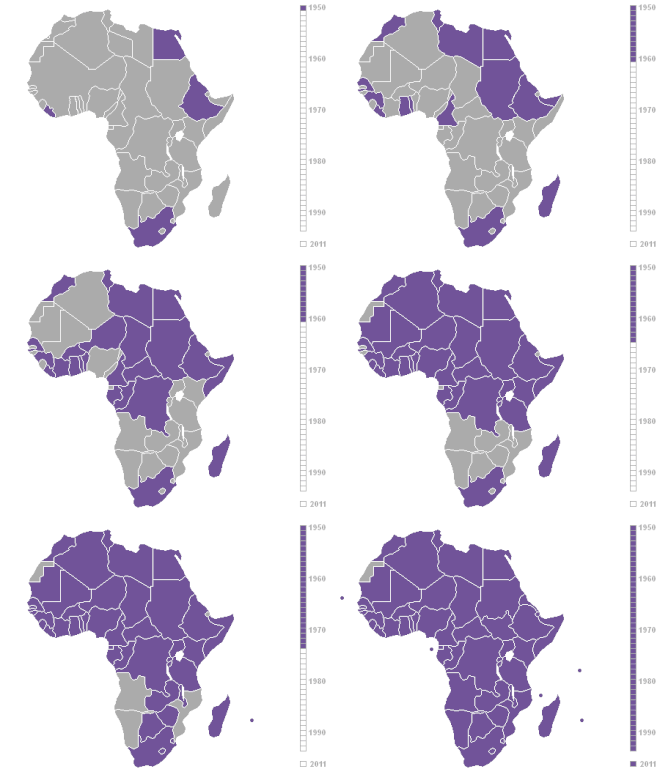
Decolonisation of Africa
The decolonisation of Africa was a series of political developments in Africa between the mid-1950s to 1975, during the Cold War. Colonial governments formed during the Scramble for Africa collapsed, giving way to sovereign states in a process characterised by violence, political upheaval, civil unrest, and organised revolts. Major events during the decolonisation of Africa include the Mau Mau rebellion, the Algerian War, the Congo Crisis, the Angolan War of Independence, the Zanzibar Revolution, and the events leading to the Nigerian Civil War.

Djenné
Djenné is a town and urban commune in the Inland Niger Delta region of central Mali. The town is the administrative centre of the Djenné Cercle, one of the eight subdivisions of the Mopti Region. The commune includes ten of the surrounding villages and in 2009 had a population of 32,944.
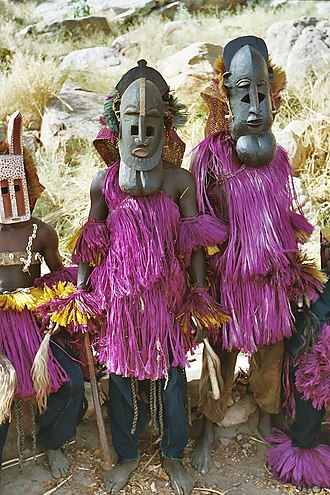
Dogon people
The Dogon are an ethnic group indigenous to the central plateau region of Mali, in West Africa, south of the Niger bend, near the city of Bandiagara, and in Burkina Faso. The population numbers between 400,000 and 800,000. They speak the Dogon languages, which are considered to constitute an independent branch of the Niger–Congo language family, meaning that they are not closely related to any other languages.

Egyptian hieroglyphs
Ancient Egyptian hieroglyphs were the formal writing system used in Ancient Egypt for writing the Egyptian language. Hieroglyphs combined ideographic, logographic, syllabic, and alphabetic elements, with more than 1,000 distinct characters. Cursive hieroglyphs were used for religious literature on papyrus and wood. The later hieratic and demotic Egyptian scripts were derived from hieroglyphic writing, as was the Proto-Sinaitic script that later evolved into the Phoenician alphabet. Egyptian hieroglyphs are the ultimate ancestor of the Phoenician alphabet, the first widely adopted phonetic writing system. Moreover, owing in large part to the Greek and Aramaic scripts that descended from Phoenician, the majority of the world's living writing systems are descendants of Egyptian hieroglyphs—most prominently the Latin and Cyrillic scripts through Greek, and the Arabic and Brahmic scripts through Aramaic. Hieroglyphs are thought to be one of four writing systems developed without outside influence, the others being Cuneiforms, Chinese characters, and Mayan script.

Geʽez script
Geʽez is an abugida used to write several Afro-Asiatic and Nilo-Saharan languages of Ethiopia and Eritrea. It originated as an abjad and was first used to write the Geʽez language, now the liturgical language of the Ethiopian Orthodox Tewahedo Church, the Eritrean Orthodox Tewahedo Church, the Eritrean Catholic Church, the Ethiopian Catholic Church, and Haymanot Judaism of the Beta Israel Jewish community in Ethiopia. In the languages Amharic and Tigrinya, the script is often called fidäl (ፊደል), meaning "script" or "letter". Under the Unicode Standard and ISO 15924, it is defined as Ge'ez text.

Great Pyramid of Giza
The Great Pyramid of Giza is the largest Egyptian pyramid. It served as the tomb of pharaoh Khufu ("Cheops"), who ruled during the Fourth Dynasty of the Old Kingdom. Built c. 2600 BC over a period of about 26 years, the pyramid is the oldest of the Seven Wonders of the Ancient World, and the only wonder that has remained largely intact. It is the most famous monument of the Giza pyramid complex, which is part of the UNESCO World Heritage Site "Memphis and its Necropolis". It is situated at the northeastern end of the line of the three main pyramids at Giza.

Haile Selassie
Haile Selassie I was Emperor of Ethiopia from 1930 to 1974. He rose to power as the Regent Plenipotentiary of Ethiopia under Empress Zewditu between 1916 and 1930.